
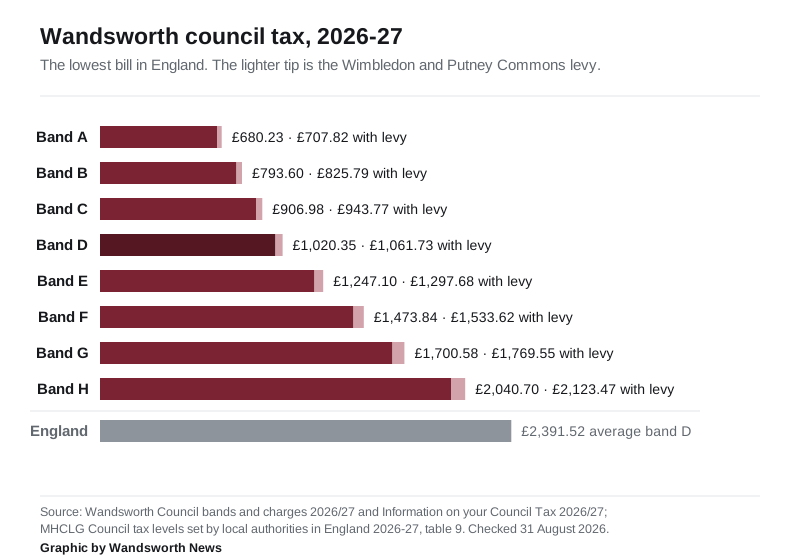
Band D is £1,020.35 in 2026-27, less than half the England average of £2,391.52. The full A to H table, plus the £41.38 commons levy that only some homes pay.
Wandsworth charges the lowest council tax in England, and the gap is not small. A band D home here pays £1,020.35 in 2026-27. The England average is £2,391.52. Cross the boundary into Lambeth and the same band D costs £2,047.11.
The figures below are Wandsworth Council’s own, from its bands and charges page and the statutory Information on your Council Tax 2026/27, checked against the government’s own council tax statistics on 31 August 2026.
The quick answer
Band D in the main part of the borough is £1,020.35 for 2026-27, made up of £509.84 for Wandsworth Council and £510.51 for the Greater London Authority. Homes in the Wimbledon and Putney Commons levy area pay £41.38 more, so £1,061.73.
The council froze its own general charge for the fourth year running. The whole 3.1 per cent increase on the bill comes from a 2 per cent adult social care precept and the GLA’s 4.1 per cent rise.
Every band, 2026-27
| Band | Main borough | With commons levy | 10 instalments | 12 instalments |
|---|---|---|---|---|
| A | £680.23 | £707.82 | £68.02 | £56.69 |
| B | £793.60 | £825.79 | £79.36 | £66.13 |
| C | £906.98 | £943.77 | £90.70 | £75.58 |
| D | £1,020.35 | £1,061.73 | £102.04 | £85.03 |
| E | £1,247.10 | £1,297.68 | £124.71 | £103.93 |
| F | £1,473.84 | £1,533.62 | £147.38 | £122.82 |
| G | £1,700.58 | £1,769.55 | £170.06 | £141.72 |
| H | £2,040.70 | £2,123.47 | £204.07 | £170.06 |
The instalment figures are the council’s own estimates for the main borough charge, before any discount or premium. Bills default to ten instalments and you can ask to spread them over twelve.
Band H in the main part of the borough, £2,040.70, still costs less than band D in Lambeth, Merton, Richmond, Croydon, Kingston or Sutton.
Why some Wandsworth bills are £41.38 higher
This is the part that generates the “why does my neighbour pay less?” question, and neither council page really explains it.
The Wimbledon and Putney Commons Conservators levy funds the upkeep of Wimbledon Common, Putney Heath and Putney Lower Common. It has been charged on nearby households since the Wimbledon and Putney Commons Act 1871, and since 1991 it has been collected through the council tax bill by Wandsworth, Merton and Kingston.
You pay it if your home is either:
- within three quarters of a mile of the perimeter of Wimbledon Common, measured by the most direct route along roads or footpaths, or
- anywhere inside the old parish of Putney as it stood in 1871, which now takes in much of Roehampton
That definition comes from the Conservators’ own explanation of the levy. The boundary was remapped by Ordnance Survey and the Conservators publish the map.
For 2026-27 the levy is £41.38 at band D, up 3.2 per cent, or £1.28 on the year. Wandsworth’s share of the total is £1,163,281, spread across a levy-area tax base of 28,109 homes. The borough’s whole tax base is 147,999, so roughly one home in five here pays it.
What makes up the bill
| Element | 2025-26 | 2026-27 | Change |
|---|---|---|---|
| Wandsworth Council, general | £417.48 | £417.66 | 0.0% |
| Wandsworth Council, adult social care | £89.89 | £100.04 | 2.0% |
| Greater London Authority | £490.38 | £510.51 | 4.1% |
| Total, average band D | £997.75 | £1,028.21 | 3.1% |
Inside the GLA’s £510.51, the police take the largest share and the only real increases this year were policing and fire:
| GLA element | 2025-26 | 2026-27 |
|---|---|---|
| Metropolitan Police (MOPAC) | £319.13 | £334.13 |
| London Fire Brigade | £71.72 | £76.85 |
| Transport for London | £77.09 | £77.09 |
| Greater London Authority | £22.44 | £22.44 |
One oddity worth knowing before you check your own bill against the council’s leaflet. The £1,028.21 band D figure the council publishes in its “combining the council tax” table is a blended average across the borough, weighted for the homes that pay the commons levy. No household actually pays it. You pay either £1,020.35 or £1,061.73. The council explains the blending on page 15 of its council tax booklet.
How that compares
Government figures for 2026-27, published by the Ministry of Housing, Communities and Local Government in Council Tax levels set by local authorities in England, put average area band D across all 296 billing authorities. Wandsworth is bottom of that list.
| Area | Average band D, 2026-27 |
|---|---|
| Wandsworth | £1,028.21 |
| Westminster | £1,049.55 |
| Hammersmith and Fulham | £1,519.51 |
| Kensington and Chelsea | £1,666.65 |
| Lambeth | £2,047.11 |
| Merton | £2,146.76 |
| Richmond upon Thames | £2,486.10 |
| England average | £2,391.52 |
That is the whole of England, not just London. The next cheapest authority, Westminster, is £21.34 dearer.
The council’s stated reason is on the record. Announcing the freeze in February 2026, leader Simon Hogg said Wandsworth has “one of the lowest levels of debt and some of the highest financial reserves in London”, and that the government had offered the council freedom to raise council tax above the 5 per cent referendum limit in future years, which it declined.
Check your band, and challenge it
Bands are set by the Valuation Office Agency, not the council, and they reflect what a property would have sold for on 1 April 1991. Nothing that has happened to house prices since changes the band.
- Look up any address free on GOV.UK’s council tax band checker
- Challenge a band through GOV.UK’s challenge service
Two practical warnings. You have to keep paying at the current band while an appeal is decided. And Wandsworth’s own bands page currently carries a notice that the VOA is running late on assessments for new developments, band changes and property splits or mergers, and that the council cannot chase the VOA for you.
A separate appeal route exists if you disagree that you are liable at all, or that the amount has been calculated correctly. That one starts with the council’s council tax service, and goes to the Valuation Tribunal if you get no answer within two months.
Discounts, exemptions and premiums
- Single adult: 25 per cent off. It also applies where everyone else in the house is disregarded, which includes full-time students, apprentices, care home patients, carers who are not a spouse or partner, and people who are severely mentally impaired.
- Disability reduction: if a room, an extra bathroom or extra wheelchair space is needed for a disabled resident, the bill drops to the band below.
- Students: a household of only full-time students is exempt, and halls of residence are exempt.
- Homes for Ukraine hosts: Ukrainian nationals on the scheme may get up to 50 per cent off.
- Second homes: furnished, and not anyone’s main residence, carries a 100 per cent premium since 1 April 2025. That doubles the bill.
- Empty homes: empty and unfurnished for more than a year adds 100 per cent, over five years 200 per cent, and over ten years 300 per cent. The trigger was cut from two years to one on 1 April 2025, and a change of ownership does not reset the clock.
Nothing is applied automatically. You have to claim it. The full list of exemption classes runs from class B for empty charity property through to class W for an annexe lived in by a relative aged 65 or over, and is in the council tax booklet.
Help if you cannot pay
Pensioners are covered by the national scheme. Working age households go into Wandsworth’s own local scheme, which for 2026-27 sorts claimants into five levels:
| Scheme | Reduction | Who it covers |
|---|---|---|
| 1 | 100% | Households on disability or carer benefits, in the ESA support group, on UC limited capability for work-related activity, or with a child under 3 and no earned income |
| 2 | 90% | Out-of-work households with dependent children on IS, JSA, ESA or UC |
| 4 | 80% | Working households with children, earning under £250 a week, or under £275 with three or more children |
| 3 | 75% | Out-of-work households with no dependent children |
| 5 | 75% | Working households with no children: single people under £125 a week, couples under £160 |
Savings rule out a claim above £6,000 for a working-age household with earned income, and above £16,000 otherwise. The eligibility detail and the scheme rules are on the Council Tax Reduction eligibility page. Pension-age residents can also claim second adult rebate based on another adult’s income.
If you are already behind, the council has a struggling to pay page, and the billing line is 020 8871 6000.
Where the money goes
Wandsworth’s council tax requirement for 2026-27 is £76.6 million, against £591.3 million of gross spending on services. Most of the rest is grant, business rates, fees and reserves. The council’s own breakdown of how the council tax pound is spent:
- Public health and adult social care, 35 per cent
- Homelessness, temporary accommodation and private sector housing standards, 13 per cent
- Waste, recycling, parks and libraries, 12 per cent
- Roads, pavements and streetlights, 10 per cent
- Children’s social care and youth services, 9 per cent
- Enabling services including customer service, the voluntary sector and finance, 21 per cent
Five outside bodies also levy on the borough. The Western Riverside Waste Authority costs Wandsworth £16.667 million for 2026-27, up 6 per cent, of which £1.479 million is the levy proper and the rest is per-tonne charges. The Wimbledon and Putney Commons special levy is £1.1 million, the Inner London Pensions Fund Authority £0.8 million, Lee Valley Regional Park Authority and the Environment Agency £0.4 million each.
Also on Wandsworth News
- Wandsworth bin collection days: free garden waste and two free bulky collections
- Parking in Wandsworth: tariffs, permits and the free bank holiday rule
- Roadworks and travel: what is shut this week
Have your say